
Like many of you I have spent significant time and money obtaining and maintaining my Project Management Professional (PMP) certification and, like some of you, I have slowly and painfully come to the conclusion that my time and money has been mostly wasted. So, why have I reached this conclusion? Two reasons.
Firstly, it is apparent to me that I’m not actually a member nor even a customer of the PMI: I’m their product. The real customer is the ecosystem of for-profit service providers (and PMI advertisers) that has accumulated around it. Every three-year certification cycle I am increasingly forced to earn PDUs by buying things from these service providers, while decreasing credit is given to the growth in my skills and experience as a practicing project manager.
Since December 2015 only 8 of the required 60 PDUs (13%) can be earned from actual project management experience; the other 52 PDUs (87%) must be obtained by paying for things from service providers or participating in internal PMI activities. Previously up to 15 of 60 PDUs (25%) could be earned form actually practicing the profession.
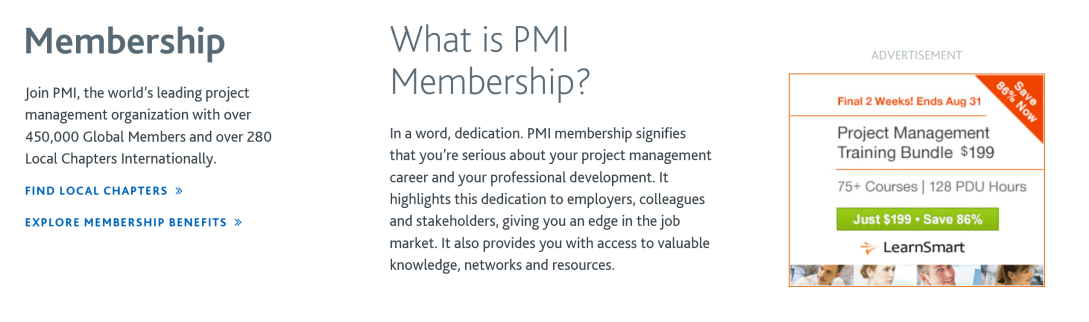
What’s odd is that the PMI does not attempt to hide this from us: the PMI homepage contains advertisements, like the one shown below, from these service providers that directly and unashamedly proclaim how many PDUs you can buy for a given price. No mention is made of how these services will make you a better project manager. The value proposition in these ads is clear – the accumulation of PDUs. PDUs are a sensible goal for a service provider selling them, but PDUs alone should never be the goal for a great project manager.
Secondly, I don’t think the PMP certification is effective at solving the central problem of project management: too many bad project managers. The certification papers over the deficiencies of poor project managers by emphasizing the learning of jargon and methodology over the acquisition of the hard and soft skills needed to be a great project manager. Talk to less experienced project managers about the benefits of PMP certification you will hear one of the following.
- It made my resume look better
- It allowed me to meet the criteria of a job description
- It was a door opener
Rarely will they tell you that certification made them a better project manager.
I recognize that I have over 20 years of high quality project management experience earned by working in some of the best professional services firms in the world (Deloitte, IBM, PricewaterhouseCoopers) and the incremental benefit of PMI activities and PMP certification are relatively small for me. Perhaps the benefits are proportionately greater for newcomers. However I suggest that those newcomers would receive an even greater benefit from simply practicing the profession mindfully and fostering a network of peers that can provide support and mentorship.
I also recognise that there is a deficit of good project managers (and a glut of bad) and that the PMI and the PMP certification encourages newcomers to enter the profession and obtain a grounding in the profession. But those benefits can be obtained by taking project management training from an employer or one of the many schools or universities that offer it, without intermediation from the PMI.
My conclusion is that the PMI and PMP certification may offer some benefit to newcomers to the project management profession, but they offer little to good and experienced project managers. And given that I only look for good and experience project managers I will no longer value seeing PMP certification on a resume. There are many better ways to be a great project manager.
More on what makes a great project manager here: https://gordontechnology.ca/2016/03/05/what-makes-a-great-project-manager/
 Gordon Technology Inc.